
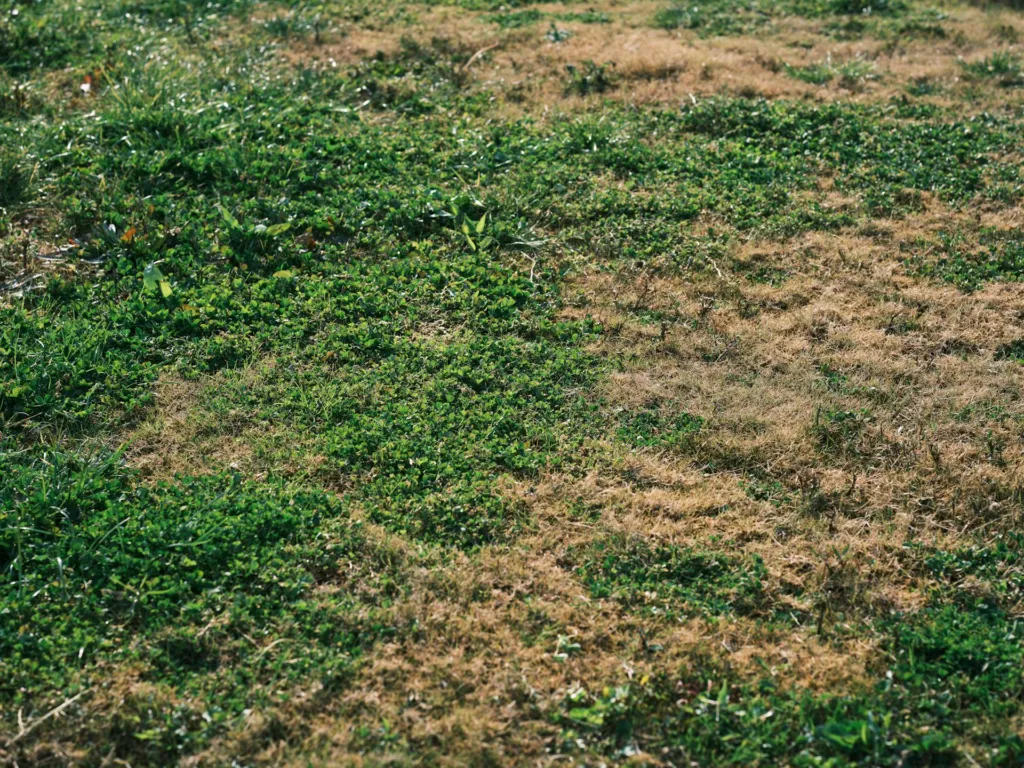
What to Do About Dead Grass In Your Lawn
There’s a Big Difference Between Dormant, Brown, and Dead Grass
You panic when seeing your lawn turn brown instead of green, right? Even the look of what passes as dead grass can make you question whether you’ve been able to maintain your lawn. And should you instantly pull it all out and leave a yard full of dirt and gravel?
It’s important not to jump to any extreme conclusions. Before you come up with a drastic plan, and make some costly mistakes, try to find out what exactly is happening with your lawn.Keep reading to discover the differences between dead grass and dormant grass. Moreover, get professional advice from the professionals at NexGreen!
Why Do Grasses Die or Become Brown?
Yes, dead brown grass can happen. But before you attempt to fix it, you must find out what killed it.
Compacted soil. The ground becomes hard due to heavy clay soil, foot traffic, or years of no aeration. There can be no extension of roots, no penetration of water, and no air getting where the grass needs it. So the lawn slowly declines.
Insects. Grubs destroy roots and kill grass at the ground level. It takes time before the damage is noticed when much of the root is lost. Insects and their larva are also harmful depending on the area and the variety of grass.
Soil pH. The grass is unable to absorb the nutrients when pH moves too far off neutral. A rangeof 6.0 to 7.0 is usually ideal in lawns. Beyond that, the grass becomes weakened steadily.
Mowing too low. Scalping or mowing more than a third of the blade is never recommended. Grass is then not able to obtain sufficient food and roots become prone to disease or drought damage.
Thatch. This is the layer of dead roots and stems which lies in between the green blades and soil. Once it grows more than half an inch, water rolls off and diseases can more easily take hold.
Lawn diseases and fungi. These are usually presented as irregular brown patches. Brown patch fungus takes the shape of large dead rings. Dollar spot forms miniature dead spots.
Dog urine. This leaves concentrated nitrogen burns in a central ring with a green edge. Pet owners see this often.
Lawn care timing. Sowing seed or applying products during an inappropriate season causes the turf to be stressed. It can also harm vast areas in your yard.
Watering errors. Providing an inadequate amount of water causes stress to the grass, the roots become short, and the plant dies. Excessive water is equally bad. Roots perish from lack of oxygen and rot. Uneven sprinkler coverage can also leave certain areas dry.
Dormant Grass vs Dead Grass
It’s not necessarily bad for grass to be dormant. Imagine the grass is just hibernating. It’s not dead, only storing power until the future. However, in the case when your lawn is really dead, the roots and crown are already beyond help.
So how are you supposed to know what’s going on? Kneel down on your lawn and peer at the bottom of the grass. When you still can see a trace of green just below the top ( where the roots of your grass are met by the shoots), it is still alive.
The other trick that can be tried is the pull test. Take some of your grass in your hand and pull it. Dormant grass will not move since the root is healthy. When you pull dead grass? It can ripped right out.
When your brown grass is an even tan color and standing tall, it’s probably just dormant. But when the color is patchy, it begins to be mushy or smell nasty, you’re getting into even bigger trouble.
Dormancy: What’s Going on Backstage?
You can have a dormant lawn in the South when it is winter. But don’t worry! It is not dead. Warm-season grasses (such as Bermuda, Zoysia, Bahia and St. Augustine) will stop growing and turn brown. This is because it’s receiving less sunlight and the cooler weather has some effect on the growth.
Why is this the case? The main reason is that photosynthesis is not easy during the winter. But nature is still busy below. The soil is being revitalized by means of decomposition and nutrient cycling, slowly releasing the nutrients which will make your lawn grow again in the spring.
With the change of seasons, energy stored in the roots and crown begins to be activated. The part where the roots of the grass meet its shoots is what is referred to as the crown. It’s the core of the plant. As the temperature rises, your lawn is starting to wake up and it will be growing and green once again.
Seasonal Differences of Dormancy
Without the proper amount of water, cool-season grasses like fescue or bluegrass will be dormant throughout summer. During July and August, they will be brown due to the heat and dryness. Healthy grass often returns in September when the temperatures will be lower.
Quite the contrary with warm-season lawns. During winter, they turn brown and then reappear in spring fresher than before. These southern grasses remain green throughout the summer season when the cool-season grasses would be dead.
Localized & Seasonal Lawn Renovation Tips
Everything depends on the place where you live. The same thing that works in the north will fail miserably in the south.
Southern Warm-Season Lawns
You have all spring to make a comeback. The best Bermuda, Zoysia, St. Augustine and Bahia months are in late April up to June.
The time of year to prepare your lawn for the next year is late summer or early fall. It will be time to give it a last application of fertilizer, to beat out those perennial weeds, and to place your affairs in such a way that your grass will go to sleep in the winter, and spring up with renewed vigor.
Northern Cool-Season Lawns
When is the best time to work on your lawn in the Midwest? Late in March and early in May, as well as late in August and early October. Actually, fall is your best chance because you do not have to suffer from summer heat immediately after the grass grows.
Overseeding in fall, after a difficult summer, fills in thin areas and allows you to plant newer and tougher types of grass. It is likely that your soil will need a nitrogen boost following winter since much of it would have washed away.
During spring, watch out for fungal problems like snow mold. When the snow melts you will find some gray, matted spots. Scrape them out and if required, use a fungicide to prevent it from spreading.
How to Solve Lawn Issues In 5 Steps
1. Figure out what went wrong.
First things first. Test your soil. It will inform you whether your lawn pH is out of whack, what nutrients it lacks, and what amount of organic content is in it. Next, find out whether water is puddling in any places following a heavy rain. That’s a bad sign.
Then take some patches of grass and examine the roots. Brown and soggy? When the roots are shallow and are dying, then you are likely to have a soil or watering problem. When they go deep and strong, then the problem is elsewhere.
2. Get your lawn ready.
Kill the weeds first. Then cut it down to approximately 1-2 inches (not so long that emerging seeds actually rest on dead grass).
Gather all the rubbish such as leaves. When the thatch layer is more than half an inch thick, tear it up.
Last step? Aerate. Punch holes in your lawn so that it can breateh. This enhances the ability of your grass to absorb water and nutrients.
3. Bring your yard back to life.
Grass seeds on hard dirt? Before they start germinating, they will dry up. And when you leave out fertilizer, the new grass that does grow will struggle.
Timing’s key. Cool-season grass prefers fall (and spring your second choice). The soil is still warm enough to allow germination of seeds. Warm-season grass? Choose late spring or early summer, when the ground is nice and warm.
When it has been spread, rake it down. Other homeowners even apply a thin bed of compost or topsoil to help.
4. Water like a pro.
Do this to maintain moist soil (not wet). That would normally mean watering every day. Perhaps twice when it is scorching or windy. All you need to do is to make sure that the top inch is wet when you poke it.
When the grass is 1-2 inches (a few weeks) long, change to longer and less frequent watering.
At week 4-6, you can take it easy and simply provide 2 inches of water per week, in one or two large drinks, not in small ones.
5. Keep it up!
Mow often, but don’t scalp it. Still cut no more than a third of the grass at a time. And water even if the new growth appears healthy.
Oh, and feed it! It should become thick and green with regular fertilizer.
FAQs About Dead Grass
Should you mow dead grass?
Yes, particularly when you are adding seed. When it is cut low, it makes you see bare areas and it also gives new seeds an improved chance to come into contact with soil.
But how long will grass survive without water?
It depends. Cool-season grasses would withstand 2-4 weeks until you can notice actual damage. Types of warm-season grass such as Bermuda are able to endure 3 to 6 weeks in the dormant state, but beyond that, they might perish due to lack of rain.
Will brown grass become green again?
If it’s only dormant, yes. It is not coming back though if it’s actually dead. Test the base of the plant by the pull test and check whether they are green.
Is it possible to plant on top of dead grass?
You may, although that seldom succeeds. Dead grass prevents the seed fro reaching the soil.
Is fertilizer going to revive dead grass?
No, fertilizer will benefit living things alone. It is also capable of strengthening healthy grass to grow faster and cover barren areas, but not dead ones.
What if some patches are dead?
Just fix those spots. You do not have to re-do your entire yard. Determine the cause of death of those areas, cure, fertilize soil, and resow. It is best to use the same kind of grass.
The Best Way to Revive Your Grass
If you don’t want to use your free time (and energy) to take care of every little lawn care detail, reach out to your local pest control experts at NexGreen. We offer lawn care services in Ohio communities around the areas of Westerville, OH and Columbus, OH.
We also provide pest control and lawn care services in Michigan for areas near Sterling Heights, MI and Rochester Mills, MI.